Plume SEO
- Year
- 2026
- Services
- Stack
- Website
- Soon
/CONTEXT
Plume is the SEO studio I designed and built for my own content sites. I kept paying for five different tools to do one job: figure out what to write, write it well, and check whether it worked.
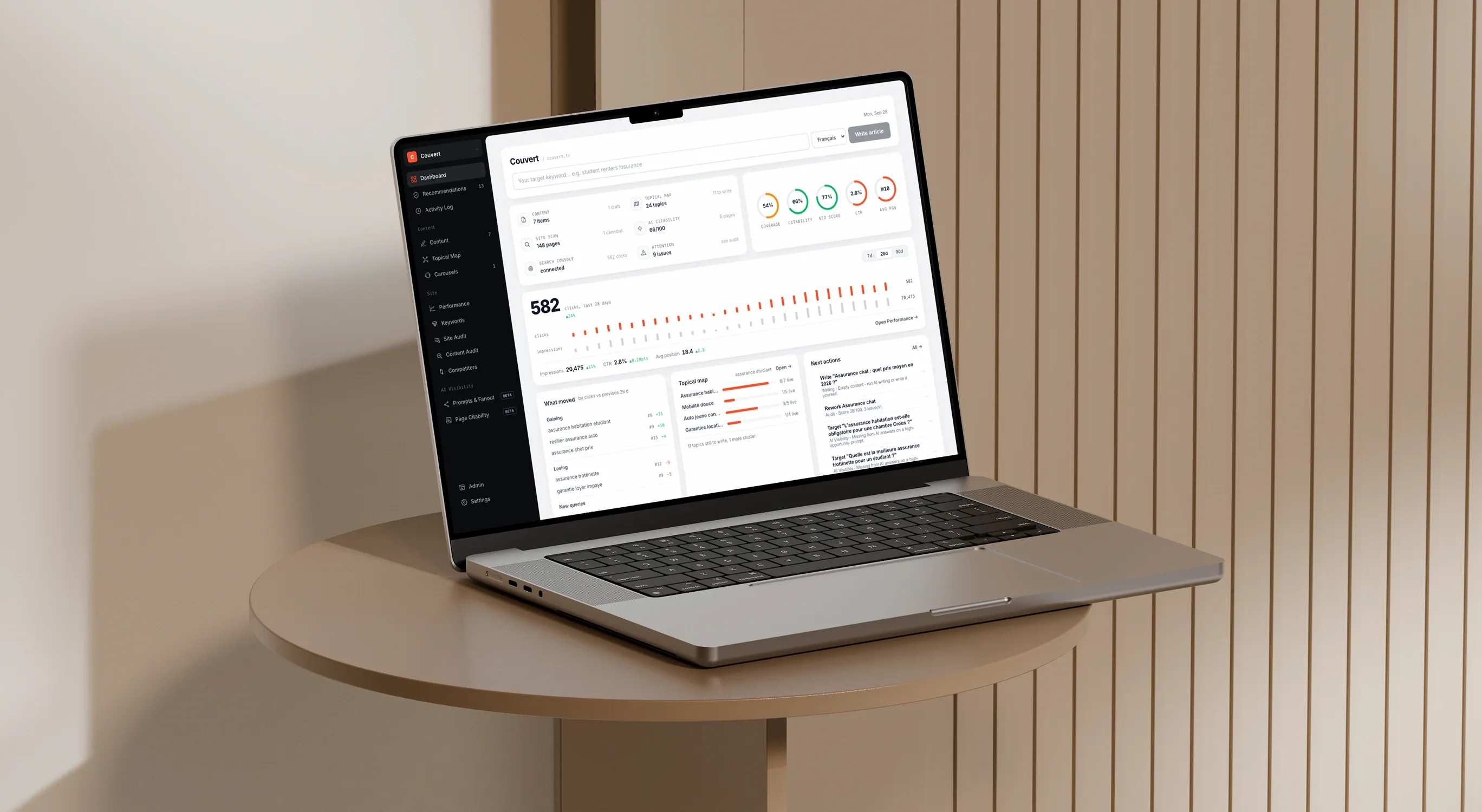
So I built the tool I wanted. Plume is a self-hosted web app that takes a site from keyword research to a published article, and tracks whether ChatGPT, Perplexity and Google's AI Overviews actually cite it. I designed the product and its interface, and built it with Claude as my engineering partner.
/PROBLEM
SEO tooling is fragmented and expensive. Keyword research lives in one tool, content scoring in another, rank tracking in a third and AI visibility in a fourth, each with its own subscription. None of them actually know your site: they ignore your existing pages, your Search Console data and your brand. AI writers fill the gap with generic content that reads like everyone else's. And search itself is shifting: ranking on Google is no longer enough, you also need to be the source that AI answers quote.
/WHAT_I_DID
I designed Plume around one loop: plan, write, measure. Topical maps are built from real keyword data and from what the site already is: its pages, its published content and its Search Console queries, so they never suggest a page that already exists. Each topic knows its page type, so a service page opens as a service page, not as another blog post. The editor scores content live for Google and for AI search, and writes with a profile set once per project: tone, point of view, audience and style rules.
Around that loop sit site and content audits, competitor gap analysis, proprietary keyword mining from Search Console, AI visibility tracking and an Instagram carousel generator with eleven art-directed templates. The interface is calm and dense, made for people who live in data: a neutral grey canvas, floating cards, monospace labels and a single accent colour reserved for data, never for buttons. All of it runs on a design system written as W3C design tokens, from which the CSS is generated.
/WORK
/RESULTS
Plume went from a frustration to a working product: 16 views covering the full SEO and GEO workflow, running on real projects with real Search Console and keyword data. It handles the unglamorous parts too: multi-user workspaces, per-person AI budgets with the real cost of every call tracked, and self-hosting so the data stays on the owner's server. A full topical map costs about 20 cents in API calls. The codebase is covered by 449 automated tests, including guards that enforce the design rules themselves, so the interface can't quietly drift.
/WHAT_I_LEARNED
Building with AI moves the hard part. Writing code got fast; deciding what deserved to be built, and cutting what looked impressive but helped no one, became the real job. The biggest wins came from product decisions, like teaching the map what a service page is, not from adding features.
I also learned that taste can be encoded. Every time I rejected a screen for feeling generic, the fix became a rule: grey, not beige. Dark buttons. Capitals only where they earn their place. Those rules now live in tokens and tests, the same systems thinking I bring to brand work, except enforced by code instead of a guidelines PDF.