Bidouille OS
- Year
- 2026
- Services
- Stack
- Website
- www.project.bidouille.studio
/CONTEXT
Bidouille Studio is a small design studio working on branding, UX/UI and Webflow websites. As projects grew, the business side ended up scattered: leads in one tool, quotes in another, contracts as PDFs, onboarding in a Tally form, and follow-ups living in my head.
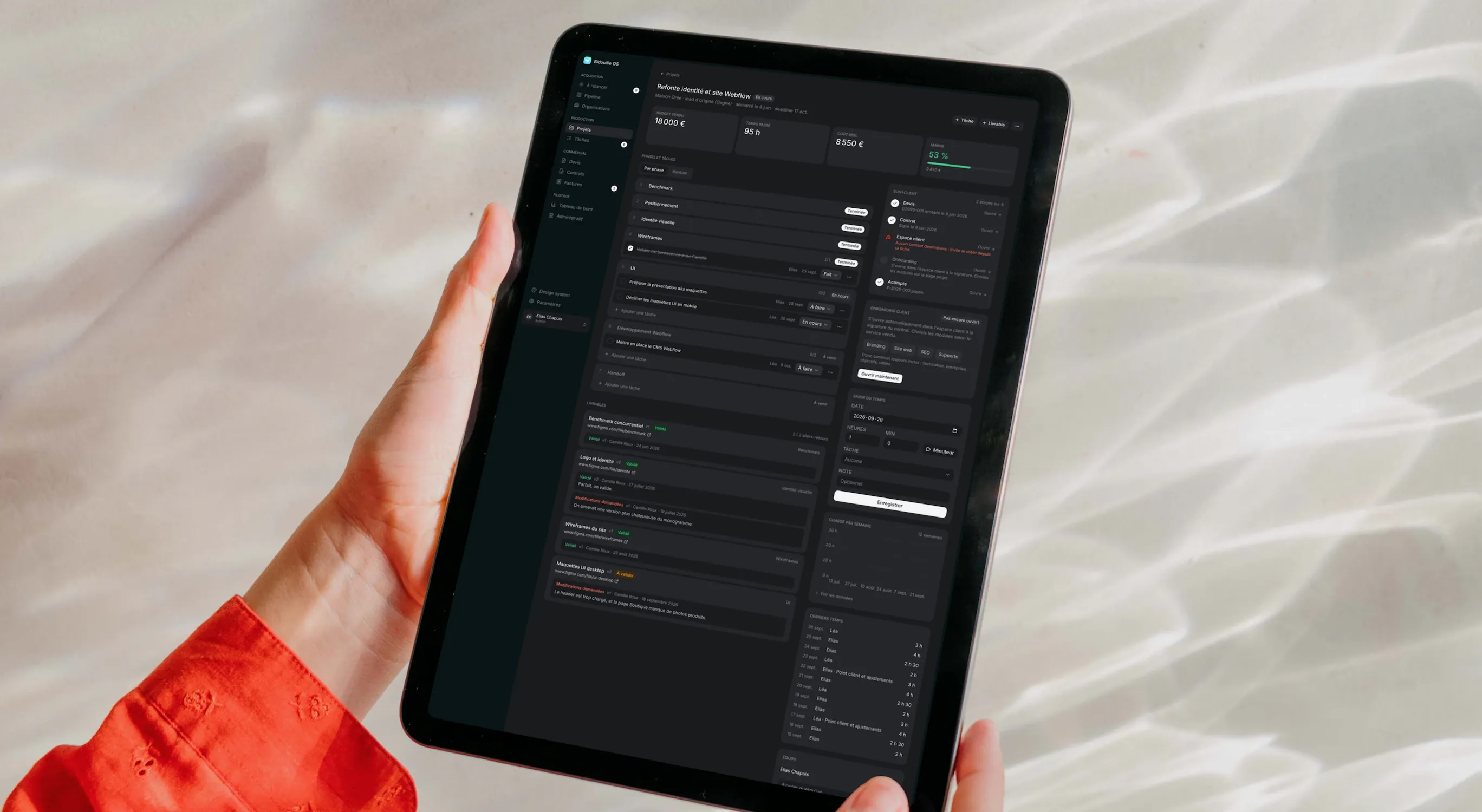
Bidouille OS is the internal tool I designed and built to bring all of it into one place, from the first conversation with a prospect to the signed contract, the client space and the final invoice.
/PROBLEM
Every new client meant the same manual chain: write the quote, send it, chase it, turn it into a contract, get it signed, open a shared space, send a questionnaire, issue the deposit invoice. Each step lived in a different tool, and nothing showed where a client actually stood.
Off-the-shelf CRMs and project tools were either too generic or too heavy for a studio our size. I needed something shaped around how we sell and deliver design work, with a client experience as considered as the work itself.
/WHAT_I_DID
I mapped the full client journey before drawing a single screen, then designed seven modules around it: pipeline, production, client portal, quotes, contracts, invoicing, dashboard and admin. Clients accept quotes and sign contracts through a private link, with no account needed, and their space opens right after signature.
I built a token-based design system with a sober black and white interface, dark mode and branded emails. Then I shipped the product myself with Superset and Claude, on Supabase and Vercel, including in-house e-signature and nightly encrypted backups.
/WORK
/RESULTS
The whole sales-to-kickoff flow now runs in one place. Accepting a quote online prepares the contract and the deposit invoice. The signature then opens the client space and an onboarding questionnaire tailored to the service sold: branding, website or SEO.
A client journey view shows at a glance where each client stands and flags what is blocking. Behind the scenes, access rules are enforced at database level, 152 automated tests cover the critical paths, and data is backed up and restore-tested every night.
/WHAT_I_LEARNED
Designing a tool for yourself is a different exercise: you are the user, the client and the stakeholder at once. Mapping the journey first kept me from piling up features and pushed me to design complete flows instead.
Building with AI changed my role more than my process. I spent less time writing code and more time making product decisions, reviewing and testing. The design system became the shared language that kept the product consistent as it grew.